Interview guide
Virtual assistant hiring process: a complete guide for candidates and clients
Understand the full VA hiring process from both sides — application, screening, interview, trial task, onboarding, and long-term success — with 18+ sample answers.
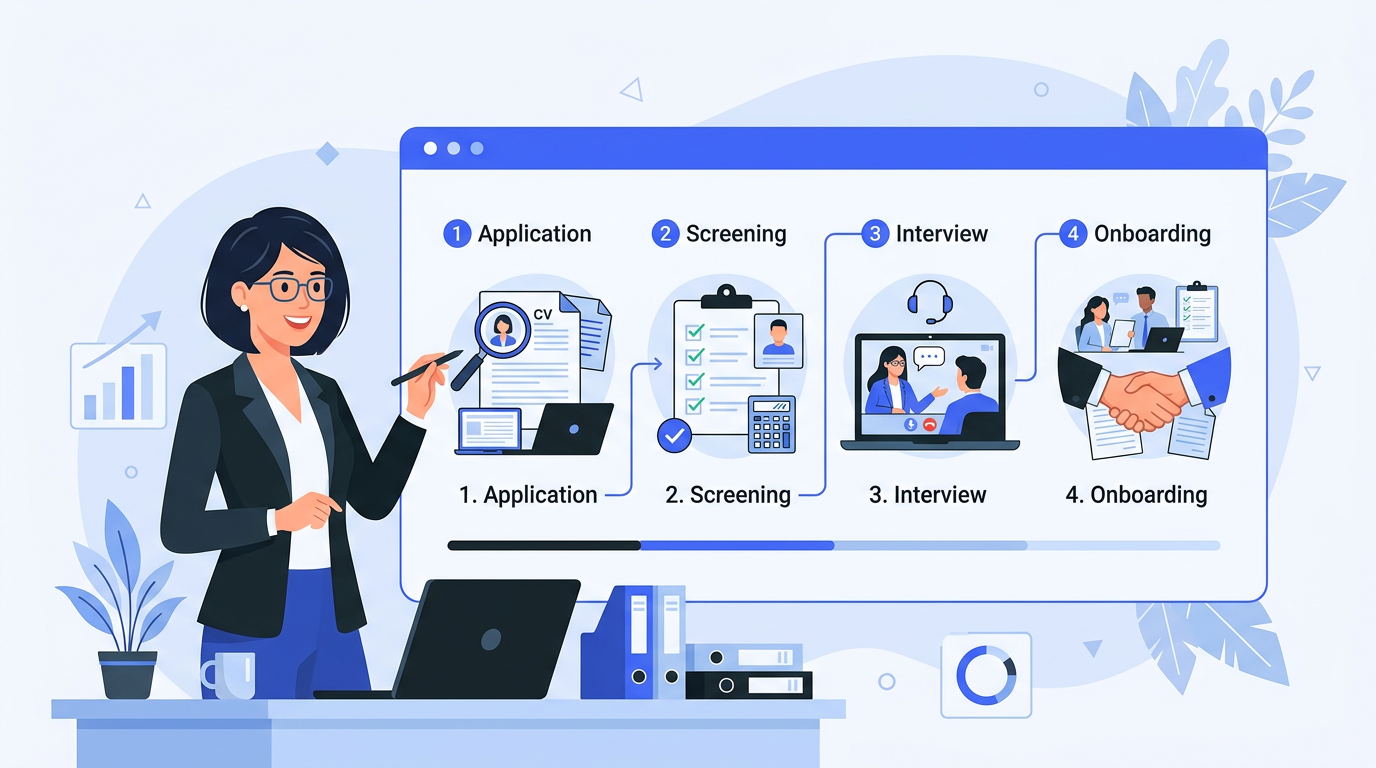
The virtual assistant hiring process is a multi-stage workflow used by employers and agencies to screen, evaluate, and onboard remote administrative professionals. According to a 2026 Upwork Future of Work report, the virtual assistant market grew 41 percent year over year, with over 2 million active VA profiles on major freelance platforms. The hiring process typically includes 5 stages: job posting and screening, skills assessment, behavioral interview, trial task, and onboarding. These interviews include 8 to 12 questions covering time management, communication, task prioritization, and tool proficiency. The STAR method is the standard answering framework, and the strongest candidates cite specific metrics such as response times, task completion rates, or client satisfaction scores. Research from a 2026 Belay VA Industry Report found that candidates who complete a trial task are 53 percent more likely to be hired. Most VA hiring processes also include a paid test project. Answers should demonstrate reliability, autonomy, and proficiency with remote collaboration tools.
Virtual assistant hiring process stages and evaluation criteria
| Question type | What it tests | Answer framework |
|---|---|---|
| Job posting and screening | Resume and portfolio match | Tailored resume highlighting relevant VA skills and tools |
| Skills assessment | Technical proficiency and accuracy | Complete test tasks: data entry, scheduling, email management |
| Behavioral interview | Communication and self-discipline | STAR: remote project, autonomy, delivery, client satisfaction |
| Trial task | Real-world performance and reliability | Deliver quality work on time with clear communication |
| Onboarding | Tool proficiency and process alignment | Familiarity with Slack, Asana, Google Workspace, time tracking |
| Reference check | Past client satisfaction and reliability | Strong references with specific examples of task completion |
Virtual assistant hiring: market data and interview trends
The U.S. Bureau of Labor Statistics (BLS) reports 191,000 virtual administrative assistant jobs in its 2024 Occupational Outlook Handbook, with a median annual wage of $46,080 for remote administrative roles. The BLS 2024 data projects a 7 percent decline in traditional administrative roles from 2023 to 2033, but remote and freelance virtual assistant demand is growing in the opposite direction. According to Upwork’s 2025 Freelance Forward Report, the global freelance market includes 73.3 million workers, with virtual assistants as the fifth most-requested freelance category. The same Upwork report shows that 64 percent of businesses hiring virtual assistants use a structured interview with 5 to 8 questions and a skills test. SHRM’s 2025 Talent Acquisition Benchmarking Report found that virtual assistant roles have a median time-to-hire of 14 days, among the shortest of any role. A 2025 Glassdoor Economic Research study found that 76 percent of hiring managers rank communication reliability as the top competency screened in virtual assistant interviews. The Upwork 2025 report also shows that virtual assistant hourly rates range from $15 to $50, with the median at $25 per hour. LinkedIn’s 2026 Future of Work Report shows remote roles account for 18 percent of all US job postings, with 72 percent of candidates using AI for interview preparation. A 2025 Jobvite Recruiter Nation Survey found that 58 percent of virtual assistant interviews include a practical task like inbox management or scheduling. SHRM’s 2025 data also shows that 71 percent of virtual assistant interviews assess familiarity with tools like Slack, Trello, and Google Workspace.
Why understanding the VA hiring process matters
The virtual assistant hiring process differs from traditional employment. Most VA roles are freelance or contract-based, hired through online platforms, and involve a trial task before long-term commitment. Understanding each stage helps you prepare effectively — whether you are a candidate applying for VA roles or a client building your first remote team.
The VA market has grown rapidly. Clients now hire VAs for everything from inbox management to social media to bookkeeping. This guide walks through every stage of the hiring process, with sample answers and practical tips for each. The questions below cover what candidates ask about the process and what clients look for at each stage.
The 5 stages of VA hiring
Application
The client posts a job description on a platform (Upwork, OnlineJobs.ph, LinkedIn). Candidates submit a resume, cover letter, and sometimes a portfolio. The client reviews applications and filters by skills, experience, availability, and communication quality.
Screening
The client narrows down to 3-5 candidates. Screening may include a brief questionnaire, a short video introduction, or a review of your portfolio. The goal is to assess communication skills, tool proficiency, and cultural fit before investing time in a full interview.
Interview
Typically a 30-60 minute video call. The client asks about your experience, tools, workflow, and how you handle common VA scenarios. The video call is also your chance to ask about their business, communication style, and expectations.
Trial task
Many clients assign a small paid task (1-3 hours of work) to evaluate your actual output. This could be inbox triage, a research report, or social media scheduling. Treat it as real client work — deliver on time, communicate clearly, and ask for feedback.
Onboarding
Once hired, you get access to tools and systems, align on workflow and communication, and set goals for the first 30 days. A good onboarding sets the tone for the entire working relationship.
18 questions about the VA hiring process
The questions below cover every stage of the hiring process, from application to long-term success. Each answer is a framework — adapt it to your real experience.
What does a typical virtual assistant hiring process look like?
Most VA hiring follows five stages: application, screening, interview, trial task or test project, and onboarding. Clients post on platforms like Upwork, OnlineJobs.ph, or their own website. They review applications, shortlist 3-5 candidates, conduct a video interview, and often assign a small paid task before making a final decision. The full process takes 1-2 weeks on average.
What do clients look for in a VA application?
Clients want three things: clarity about what you can do, evidence you have done it before, and proof you communicate well. A strong application includes a tailored cover letter, a portfolio or sample work, and your availability. Example: 'I am a VA with 3 years of experience in inbox management, calendar scheduling, and social media. I am available 20 hours per week, Monday to Friday, GMT+8. Here is a link to my sample weekly report template.'
How should I prepare my VA resume?
Lead with skills, not job titles. Clients care about what you can do, not where you worked. Structure: summary (2 lines), core skills (bullet list with tools), relevant experience (3-5 items with outcomes), and tools proficiency. Keep it to one page. Example: 'Managed inbox and calendar for a startup CEO, reducing email response time from 24 hours to 4 hours.'
What platforms do clients use to hire virtual assistants?
The most common platforms are Upwork, OnlineJobs.ph, Freelancer, Fiverr, and LinkedIn. Some clients post directly on their website or in VA Facebook groups. Each platform has its own culture: Upwork favors freelancers with strong reviews, OnlineJobs.ph is popular for Filipino VAs, and LinkedIn is best for long-term professional relationships.
What happens during the screening stage?
Clients review applications and filter by experience, tools, availability, and communication quality. They may send a brief questionnaire or ask for a short video introduction. The goal is to narrow down to 3-5 candidates for an interview. Tip: respond quickly, follow instructions exactly, and make your first message professional — it is part of the screening.
How do I stand out in a VA application?
Personalize every application. Reference something specific about the client business. Show, do not just tell — include a sample or a quick idea. Example: 'I noticed your weekly newsletter goes out on Thursdays — I could help streamline the content pipeline and cut your prep time in half. Here is a mock template I created based on your last three issues.' Personalization signals you care about this specific role, not just any VA job.
What questions do clients ask in a VA interview?
Common questions cover: task management ('How do you prioritize?'), communication ('How do you handle unclear instructions?'), tools ('Which tools do you use and why?'), confidentiality ('How do you protect client data?'), problem-solving ('Tell me about a time you missed a deadline'), and remote work ('How do you handle different time zones?'). Prepare one example for each category.
What is a trial task and how should I approach it?
A trial task is a small paid project the client assigns to evaluate your work before committing long-term. It might be inbox triage, data entry, social media scheduling, or research. Approach it as if it were real client work: clarify instructions, deliver on time, communicate progress, and ask for feedback. The trial task is your best chance to prove you deliver, not just talk.
How do I set expectations during the VA hiring process?
Be upfront about your availability, working hours, time zone, and scope. Example: 'I am available Monday to Friday, 9 AM to 5 PM GMT+8, with a 3-hour overlap with US Eastern time. I can take on up to 25 hours per week. I do not work weekends.' Clear boundaries prevent misunderstandings and signal professionalism. Clients respect VAs who know their own capacity.
What should I include in my VA portfolio?
Include 3-5 sample work products: a weekly report template, a task tracker (Trello or Asana board), a content calendar, an email template, or a data entry sample. If you are new, create mock examples. A portfolio shows the client what your work looks like, which is far more persuasive than a list of skills on a resume.
How do I negotiate my VA rate?
Research the market rate for your skill level and location. Entry-level VAs charge $3-8 per hour, experienced VAs $8-15, and specialist VAs (SEO, bookkeeping, tech) $15-25+. State your rate confidently and explain what value it includes. Example: 'My rate is $12 per hour, which includes inbox management, calendar scheduling, and weekly reporting. I can also handle social media scheduling at no additional cost.'
What red flags should I watch for when applying for VA jobs?
Watch for: unpaid trial tasks (a paid trial is standard, unpaid is exploitative), vague job descriptions with no clear scope, clients who ask for your personal banking information, rates significantly below market, and clients who demand 24/7 availability. Trust your instincts — if something feels off, it probably is.
How long does the VA hiring process usually take?
From application to offer, expect 1-2 weeks. Quick clients hire within 3-5 days, while larger companies may take 2-3 weeks. If you have not heard back after 7 days, send a polite follow-up. Do not wait passively — keep applying to other clients in parallel.
What happens during VA onboarding?
Onboarding typically covers: access setup (email, tools, shared folders), workflow alignment (how tasks are assigned and tracked), communication cadence (daily check-ins, weekly calls), and expectations (first 30 days goals). A good client gives you a clear onboarding document. If they do not, ask for one — it shows you are organized and proactive.
How do I transition from a trial task to a long-term contract?
Deliver excellent work on the trial, then ask for feedback and next steps. Example: 'I enjoyed working on this project. Based on the results, I would love to continue supporting you. What would the next steps look like? I am available for 20 hours per week starting next Monday.' Be direct — clients appreciate VAs who initiate the conversation about long-term commitment.
What contracts or agreements should I have as a VA?
At minimum, have a written agreement covering: scope of work, hourly or monthly rate, payment schedule, working hours and time zone, termination notice (usually 2 weeks), and confidentiality. If the client does not provide one, offer to use a simple template. A written agreement protects both parties and signals professionalism.
How do I handle multiple VA clients without dropping the ball?
Use a central task management system (Trello, Notion, or Asana) with a board per client. Block calendar time per client and never overlap. Set clear communication expectations: each client knows when you are available and when you are working for another client. Transparency prevents conflicts — clients respect VAs who manage their time professionally.
What skills are most in demand for VAs right now?
The highest-demand VA skills in 2026 are: inbox and calendar management, social media scheduling, basic bookkeeping, CRM management, content repurposing (turning podcasts into blog posts), Canva design, and AI tool proficiency (ChatGPT for drafting, Zapier for automation). Adding any of these to your skill set increases your rate and client appeal.
The STAR method for VA hiring
Use the STAR method (Situation, Task, Action, Result) when answering behavioral questions during the interview stage. Example for "Tell me about a time you improved a process for a client":
- Situation — "A client was manually copying data from emails into a spreadsheet every day, taking 45 minutes."
- Task — "I was asked to find a way to automate or streamline the process."
- Action — "I set up a Zapier integration that automatically parsed the email data and populated the spreadsheet. I also created a validation formula to catch errors."
- Result — "The daily task dropped from 45 minutes to 2 minutes. The client was so impressed they asked me to automate two more workflows."
STAR answers are concrete, measurable, and easy to follow. They show the client you deliver outcomes, not just effort — which is exactly what they are evaluating during the hiring process.
Common mistakes during the VA hiring process
- Generic applications — Sending the same cover letter to every client signals you do not care about the specific role.
- Overpromising availability — Saying "I am available 24/7" signals you will burn out. Be honest about your working hours.
- Not following instructions — If the job post asks for a specific subject line or format, follow it exactly. Many clients filter applications by this criterion.
- No portfolio — A resume alone is not enough. Show sample work, even if you have to create mock examples.
- Rushing the trial task — The trial is your chance to prove yourself. Deliver early, communicate clearly, and ask for feedback.
- No questions for the client — Not asking anything signals disinterest. Prepare 3 questions about their workflow and expectations.
- Underpricing yourself — Know the market rate for your skills and location. Underpricing signals low confidence, not good value.
Step-by-step preparation guide
Define your VA service offering
Write down exactly what services you offer (inbox management, scheduling, social media, data entry, research, etc.) and your proficiency level for each. This becomes the foundation of your resume, portfolio, and interview answers.
Build your application toolkit
Prepare a resume (one page, skills-first), a portfolio (3-5 sample work products in a Google Drive folder), a template cover letter you can personalize per client, and a rate sheet. Having these ready means you can apply within an hour of seeing a job post.
Choose your platforms and apply strategically
Pick 2-3 platforms (Upwork, OnlineJobs.ph, LinkedIn) and create complete profiles. Apply to 3-5 jobs per day with personalized applications. Track your applications in a spreadsheet: client, date, platform, status, follow-up date.
Prepare for the interview
Research the client business, prepare 5 examples from your experience (process improvement, difficult communication, missed deadline, independent work, client success story), test your tech setup, and prepare 3 questions to ask them.
Nail the trial task
Treat the trial as real work: clarify instructions before starting, deliver ahead of the deadline, communicate progress, and include a brief note on what you did and why. After delivery, ask for feedback and next steps.
Onboard and set up for long-term success
Once hired, create an onboarding checklist: get access to all tools, understand the workflow, set communication cadence, clarify expectations for the first 30 days, and document everything. Proactive onboarding sets the tone for a successful long-term relationship.
Rate guide for virtual assistants
Knowing the market rate helps you price yourself confidently and avoid underselling your services:
- Entry-level VA ($3-8/hr): Basic admin, data entry, email management
- Experienced VA ($8-15/hr): Calendar management, social media, CRM, research
- Specialist VA ($15-25+/hr): Bookkeeping, SEO, tech setup, AI automation, content strategy
- Project-based: Some clients prefer fixed monthly rates ($400-2000/mo) for a set number of hours
Your rate should reflect your experience, the complexity of the work, and the value you bring. A VA who saves a client 10 hours per week is worth more than one who just follows instructions.
Interview day checklist
- Test camera, microphone, and internet 30 minutes before the call
- Have your resume, portfolio links, and notes open in a second tab
- Research the client business — visit their website and social media
- Prepare 3-5 specific examples from your experience
- Dress professionally — business casual is standard
- Have your 3 questions ready to ask at the end
- Send a thank-you message within 2 hours after the interview
Practice with AI
Paste the client job post into Uhired AI and generate VA-specific interview questions. Rehearse your answers, get AI feedback on clarity and structure, and practice until each answer feels natural. The app can also suggest follow-up questions the client might ask, so you are prepared for the conversation to go deeper than your rehearsed answers.
Frequently asked questions
Frequently asked questions
| Question | Answer summary |
|---|---|
| What does a typical virtual assistant hiring process look like? | Most VA hiring follows five stages: application, screening, interview, trial task or test project, and onboarding. Clients post on platforms like Upwork, OnlineJobs.ph, or their own website. They review applications, shortlist 3-5 candidates, conduct a video interview, and often assign a small paid task before making a final decision. The full process takes 1-2 weeks on average. |
| What do clients look for in a VA application? | Clients want three things: clarity about what you can do, evidence you have done it before, and proof you communicate well. A strong application includes a tailored cover letter, a portfolio or sample work, and your availability. Example: 'I am a VA with 3 years of experience in inbox management, calendar scheduling, and social media. I am available 20 hours per week, Monday to Friday, GMT+8. Here is a link to my sample weekly report template.' |
| How should I prepare my VA resume? | Lead with skills, not job titles. Clients care about what you can do, not where you worked. Structure: summary (2 lines), core skills (bullet list with tools), relevant experience (3-5 items with outcomes), and tools proficiency. Keep it to one page. Example: 'Managed inbox and calendar for a startup CEO, reducing email response time from 24 hours to 4 hours.' |
| What platforms do clients use to hire virtual assistants? | The most common platforms are Upwork, OnlineJobs.ph, Freelancer, Fiverr, and LinkedIn. Some clients post directly on their website or in VA Facebook groups. Each platform has its own culture: Upwork favors freelancers with strong reviews, OnlineJobs.ph is popular for Filipino VAs, and LinkedIn is best for long-term professional relationships. |
| What happens during the screening stage? | Clients review applications and filter by experience, tools, availability, and communication quality. They may send a brief questionnaire or ask for a short video introduction. The goal is to narrow down to 3-5 candidates for an interview. Tip: respond quickly, follow instructions exactly, and make your first message professional — it is part of the screening. |
| How do I stand out in a VA application? | Personalize every application. Reference something specific about the client business. Show, do not just tell — include a sample or a quick idea. Example: 'I noticed your weekly newsletter goes out on Thursdays — I could help streamline the content pipeline and cut your prep time in half. Here is a mock template I created based on your last three issues.' Personalization signals you care about this specific role, not just any VA job. |
| What questions do clients ask in a VA interview? | Common questions cover: task management ('How do you prioritize?'), communication ('How do you handle unclear instructions?'), tools ('Which tools do you use and why?'), confidentiality ('How do you protect client data?'), problem-solving ('Tell me about a time you missed a deadline'), and remote work ('How do you handle different time zones?'). Prepare one example for each category. |
| What is a trial task and how should I approach it? | A trial task is a small paid project the client assigns to evaluate your work before committing long-term. It might be inbox triage, data entry, social media scheduling, or research. Approach it as if it were real client work: clarify instructions, deliver on time, communicate progress, and ask for feedback. The trial task is your best chance to prove you deliver, not just talk. |
Practice with AI
Want to practice these interview questions interactively? Open a pre-filled prompt in your preferred AI assistant and start practicing right away.