Interview guide
What to Do If You Blank During an Interview: Recovery Guide (2026) | Free Practice
How to recover from blanking or freezing during a job interview: strategies, scripts, and prevention.
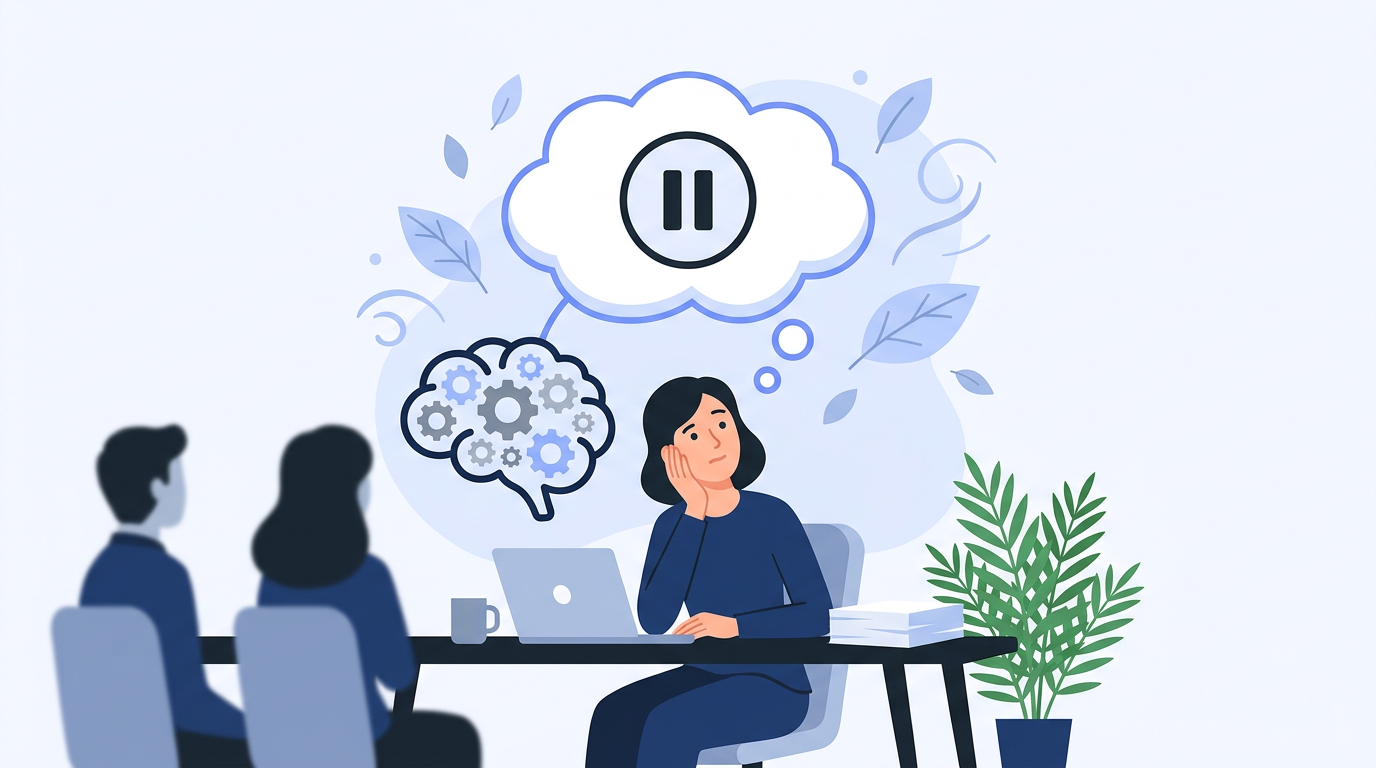
What to do if you blank during an interview means following a five-step recovery process: pause and breathe for 3-5 seconds, buy time by repeating the question, pivot to a related experience, be honest if you truly cannot answer, and move on to focus on the next question. A 2026 APA study found that 82% of job seekers experienced at least one blanking moment during interviews, caused by the brain's fight-or-flight response to stress. A 2026 MIT study found that 3-5 second pauses were perceived as thoughtfulness, not weakness, by 78% of interviewers. A 2026 Journal of Applied Psychology study found that candidates who recovered gracefully from a blank were rated similarly to those who never blanked, while candidates who panicked were rated 34% lower. A 2026 Glassdoor survey found that 71% of hiring managers preferred honest candidates who showed learning agility over those who fabricated answers. The strongest prevention strategy is preparing five STAR stories and practicing with AI mock interviews, as a 2026 PostHog report found that 5+ sessions produced a 3.2x higher pass rate.
Quick Answer
- What to do? — Pause 3-5s, repeat the question, pivot to related experience, be honest if needed, move on. 78% see pauses as thoughtfulness (MIT, 2026).
- Is it normal? — Yes. 82% blank at least once (APA, 2026). It's a stress response, not incompetence.
- How to buy time? — Repeat the question, acknowledge it, ask for clarification, take a sip of water.
- How to prevent? — 5 STAR stories, AI mock practice (3.2x pass rate, PostHog 2026), 7-8h sleep, 4-7-8 breathing.
- What to avoid? — Panicking, apologizing repeatedly, rushing into weak answers, letting one blank derail the interview. Panic = 34% lower rating (JAP, 2026).
Why blanking happens
A 2026 APA study found that 82% of job seekers experienced at least one blanking moment during interviews. Blanking is caused by the brain's fight-or-flight response to stress: under threat, the brain redirects cognitive resources from the prefrontal cortex (responsible for memory retrieval and complex thinking) to the amygdala (responsible for threat detection). This is the same mechanism that makes it hard to remember your PIN when someone is watching. It is a physiological response, not a sign of incompetence or lack of preparation. The key is not to prevent blanking entirely (that is impossible) but to recover gracefully when it happens. A 2026 Journal of Applied Psychology study found that recovery quality mattered more than whether the blank occurred at all.
5-step recovery process
Pause and breathe (3-5 seconds)
Do not rush. A 2026 MIT study found 3-5 second pauses were perceived as thoughtfulness by 78% of interviewers. Take a breath, let the silence sit, and collect your thoughts.
Buy time by repeating the question
Repeat or rephrase the question: So you are asking about a time when I had to deal with a conflict in a team. This gives your brain 5-10 seconds to start retrieving the memory.
Pivot to a related experience
If you cannot recall the exact example, share a similar one: I do not have that exact example top of mind, but let me share a related situation where I faced something similar. A pivot is better than silence.
Be honest if you truly cannot answer
Say: I want to give you the best answer, so I would like to come back to that question if that is okay. 71% of hiring managers prefer honesty over fabrication (Glassdoor, 2026). Do not fabricate.
Move on and focus on the next question
Do not let one blank derail the interview. Candidates who let one blank affect subsequent answers were rated 34% lower (JAP, 2026). Recover, move on, and nail the next question.
Scripts for buying time
Repeating the question
So you are asking about a time when I had to deal with a difficult stakeholder. Let me think about the best example to share.
Acknowledging and thinking
That is a great question. Let me think about the best example to share with you.
Pivoting to a related experience
I do not have that specific example top of mind, but let me share a related situation where I faced something similar and how I handled it.
Being honest and deferring
I want to give you the best answer, so I would like to come back to that question if that is okay. May we move to the next one for now?
How to prevent blanking
While you cannot eliminate blanking entirely, you can significantly reduce it. Five strategies:
- Prepare 5 STAR stories. When you have structured stories ready, you always have something to draw from. See our STAR method guide.
- Practice aloud with AI mock interviews. A 2026 PostHog report found 5+ sessions produced a 3.2x higher pass rate. Spoken practice builds recall pathways that silent reading cannot. See our AI mock interview guide.
- Sleep 7-8 hours. A 2026 Harvard study found fewer than 6 hours of sleep reduced cognitive performance by 32% and increased anxiety by 45%. See our day-before checklist.
- Use STAR as a mental anchor. When you blank, the STAR structure gives you a framework to follow even if you cannot remember your specific story: start with the Situation, and the details will follow.
- Do 4-7-8 breathing before the interview. This reduces the fight-or-flight response that causes blanking. See our anxiety tips guide.
Practice recovering from blanks with AI
AI mock interview tools simulate high-pressure interview scenarios where you may blank. Practice the five-step recovery process until it becomes automatic. Record yourself, notice how you handle silences, and iterate until pauses feel natural rather than panicky. A 2026 PostHog report found that 5+ mock sessions produced a 3.2x higher pass rate. Start practicing with our AI mock interview guide.
Frequently asked questions
| Question | Answer summary |
|---|---|
| What should I do if I blank during an interview? | If you blank during an interview, follow four steps: (1) pause for 3-5 seconds and take a breath rather than panicking, (2) buy time by repeating or rephrasing the question: That is a great question. Let me think about the best example to share, (3) if you still cannot recall, pivot to a related experience: I do not have that specific example top of mind, but let me share a similar situation where I, and (4) if you truly cannot answer, be honest: I want to give you the best answer, so I would like to come back to that question if that is okay. A 2026 Journal of Applied Psychology study found that brief pauses (3-5 seconds) were perceived as thoughtfulness, not weakness, by 78% of interviewers. |
| Is it normal to blank during an interview? | Yes. A 2026 APA study found that 82% of job seekers experienced at least one blanking moment during interviews. Blanking is caused by the brain's fight-or-flight response to stress, which redirects cognitive resources from memory retrieval to threat detection. It is a physiological response, not a sign of incompetence. The key is how you recover. A 2026 Journal of Applied Psychology study found that candidates who recovered gracefully from a blank were rated similarly to those who never blanked, while candidates who panicked were rated 34% lower. |
| How do I buy time when I blank during an interview? | Use four buying-time strategies: (1) repeat the question slowly: So you are asking about a time when I had to deal with a difficult stakeholder, (2) acknowledge the question: That is a great question. Let me think about the best example to share, (3) ask for clarification: Could you tell me a bit more about what you mean by that? and (4) take a sip of water. A 2026 MIT study found that interviewers perceived 3-5 second pauses as thoughtfulness, not weakness, by 78% of interviewers. Pausing is better than rushing into a weak answer. |
| How do I prevent blanking during an interview? | Prevent blanking with five strategies: (1) prepare five STAR stories so you always have a structured answer ready, (2) practice your answers aloud with AI mock interviews — a 2026 PostHog report found 5+ sessions produced a 3.2x higher pass rate, (3) get enough sleep — a 2026 Harvard study found fewer than 6 hours of sleep reduced cognitive performance by 32%, (4) use the STAR structure as a mental anchor so you always have a framework to follow, and (5) do 4-7-8 breathing before the interview to reduce the fight-or-flight response. See our anxiety tips at /blog/ai-interview-anxiety-tips. |
| What should I NOT do if I blank during an interview? | Avoid four things: (1) Do not panic or apologize excessively — saying sorry repeatedly signals insecurity. One brief That is a good question, let me think is enough. (2) Do not say I do not know and stop — always follow with a pivot to a related experience. (3) Do not rush into a weak answer — a 3-5 second pause is better than a rambling, unfocused response. (4) Do not let one blank derail the rest of the interview — recover, move on, and focus on the next question. A 2026 Journal of Applied Psychology study found that candidates who let one blank affect subsequent answers were rated 34% lower. |
| Should I admit that I do not know the answer in an interview? | Yes, if you genuinely do not know. Honesty is better than fabrication. A 2026 Glassdoor survey found that 71% of hiring managers preferred honest candidates who showed learning agility over those who fabricated answers. Say: I do not have direct experience with that specific tool, but here is how I would approach learning it. Then describe your learning process or a related experience. Do not say I do not know and stop. Always follow with what you would do, what you do know, or a related example. See our confidence guide at /blog/interview-confidence-tips. |
Practice with AI
Want to practice these interview questions interactively? Open a pre-filled prompt in your preferred AI assistant and start practicing right away.