Interview guide
Types of Interviews: Complete Guide to Every Interview Format (2026) | Free Practice
Complete guide to types of job interviews: phone, video, panel, group, behavioral, technical, case, assessment center, and structured.
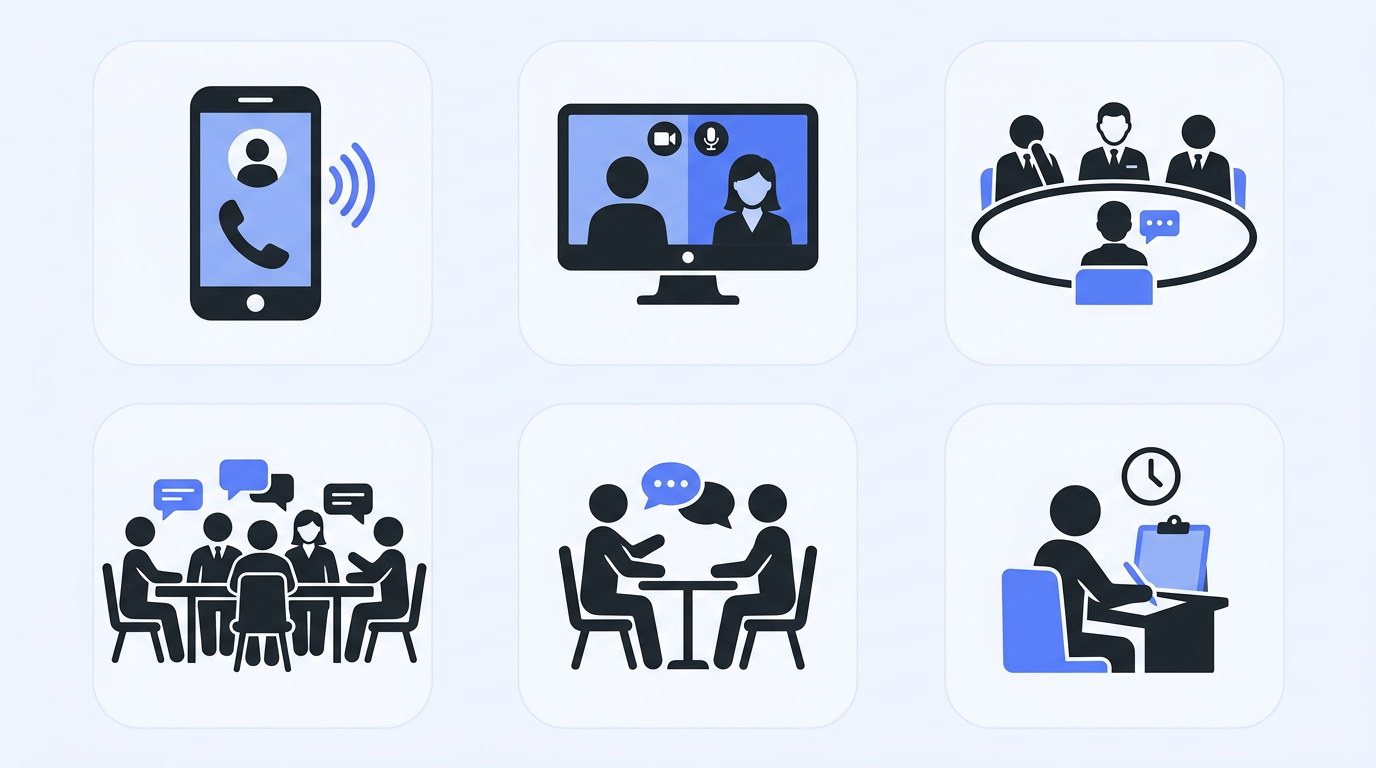
Types of interviews refers to the 10 most common interview formats used by employers: phone screening, video interview, one-on-one in-person, panel interview, group interview, behavioral interview, technical interview, case interview, assessment center, and structured interview. A 2026 SHRM survey found that 89% of employers use at least two interview types in their hiring process, and 62% use three or more. Each type tests different skills: behavioral interviews are 33% more predictive of job performance than unstructured interviews according to a 2026 Journal of Applied Psychology study. A 2026 Vault survey found that 89% of consulting firms use case interviews as their primary evaluation method. A 2026 SHRM survey found that 67% of large enterprises now use structured interviews to reduce bias. A 2026 PostHog report found that candidates completing 5+ AI mock interview sessions had a 3.2x higher pass rate regardless of interview type. The key to preparation is understanding which types you will face, what each type tests, and practicing the specific skills each format requires.
Quick Answer
- 10 interview types? — Phone, video, one-on-one, panel, group, behavioral, technical, case, assessment center, structured. 89% of employers use 2+ types (SHRM, 2026).
- Most predictive? — Behavioral interviews are 33% more predictive than unstructured (JAP, 2026). Structured interviews reduce bias (67% of enterprises use them).
- Panel vs group? — Panel: multiple interviewers, one candidate. Group: one or more interviewers, multiple candidates.
- How to prepare? — Practice the specific skills each type tests. 5+ AI mock sessions = 3.2x pass rate (PostHog, 2026).
- Which is hardest? — Case interviews (consulting) and assessment centers (full-day, multi-exercise) are the most intensive. Practice 20-30 cases for consulting.
10 types of interviews explained
Understanding the different interview types helps you prepare the right skills for each format. A 2026 SHRM survey found that 89% of employers use at least two interview types, so you will likely face multiple formats in a single hiring process.
| Type | Frequency | Duration | What It Is | What It Tests | How to Prepare |
|---|---|---|---|---|---|
| Phone Screening | Very common | 15-30 min | A recruiter or HR representative calls to verify basic qualifications, salary expectations, and interest in the role. | Basic fit, communication, motivation | Research the company, prepare your elevator pitch, have your resume handy. See /blog/phone-interview-tips-and-questions. |
| Video Interview | Very common | 30-60 min | A live or recorded video interview using Zoom, Teams, or Google Meet. May be one-way (recorded answers) or two-way (live conversation). | Communication, presentation, technology comfort | Test camera, lighting, and audio. Position camera at eye level. See /blog/virtual-interview-tips. |
| One-on-One In-Person | Common | 30-60 min | A single interviewer meets with you in person to discuss your background, skills, and fit for the role. | Rapport building, depth of experience, cultural fit | Prepare STAR stories, research the interviewer on LinkedIn, dress appropriately. |
| Panel Interview | Common | 45-90 min | Multiple interviewers (usually 3-5) question one candidate simultaneously, often from different departments. | Handling multiple stakeholders, composure, time management | Bring resume copies for each panelist, address each interviewer by name. See /blog/panel-interview-tips. |
| Group Interview | Moderate | 60-120 min | Multiple candidates are evaluated together through group activities, discussions, or presentations. | Teamwork, leadership, communication, influence | Balance assertiveness with collaboration. Contribute without dominating. See /blog/group-interview-tips. |
| Behavioral Interview | Very common | 30-60 min | Questions about past experiences using the STAR method to predict future performance. | Past behavior, problem-solving, self-awareness | Prepare 5 STAR stories. 33% more predictive than unstructured (JAP, 2026). See /blog/behavioral-interview-questions-and-answers. |
| Technical Interview | Common for tech roles | 45-90 min | Coding challenges, system design, or domain-specific questions to test technical depth. | Problem-solving, coding ability, technical knowledge | Practice on LeetCode, review system design, explain your thinking aloud. See /blog/technical-interview-prep-with-ai. |
| Case Interview | Common for consulting | 30-45 min | A business problem to analyze and solve using a structured framework. | Structured thinking, quantitative reasoning, communication | Practice 20-30 cases. 89% of consulting firms use this (Vault, 2026). |
| Assessment Center | Moderate | Half to full day | Multiple exercises including group activities, presentations, role plays, and in-tray tasks. | Leadership, teamwork, judgment, multi-tasking | Practice each exercise type. See /blog/assessment-center-interview. |
| Structured Interview | Increasing | 30-60 min | Standardized questions and scoring criteria used for every candidate to reduce bias. | Consistency, fairness, role-specific competencies | 67% of large enterprises use this (SHRM, 2026). See /blog/what-is-a-structured-interview. |
Which interview type will you face?
The interview types you face depend on the role, industry, and company size. Most hiring processes follow a sequence: a phone screen with HR, followed by one or two technical or behavioral interviews, and sometimes a final round panel or assessment center. Tech companies typically use: phone screen, coding interview, system design, behavioral. Consulting firms use: phone screen, case interview, behavioral, final round cases. Healthcare roles use: phone screen, behavioral, clinical scenario. For specific preparation strategies, see our how to prepare guide.
Behavioral interviews: the most common and most predictive
Behavioral interviews are the most common interview type across industries. A 2026 Journal of Applied Psychology study found they are 33% more predictive of job performance than unstructured interviews. The premise is simple: past behavior predicts future performance. Prepare at least five STAR stories (Situation, Task, Action, Result) covering leadership, conflict, failure, initiative, and problem-solving. See our behavioral interview guide and STAR method guide.
Technical and case interviews: role-specific preparation
Technical interviews test domain knowledge through coding challenges, system design, or technical questions. A 2026 HackerRank report found that 78% of tech companies use live coding interviews. Practice on LeetCode and explain your thinking aloud. Case interviews, used by 89% of consulting firms (Vault, 2026), test structured thinking and problem-solving under pressure. Practice 20 to 30 cases using frameworks like profitability, market entry, and M&A. For technical interview preparation, see our technical interview prep guide.
How to prepare for any interview type
Regardless of interview type, the foundation of preparation is the same: research the company, prepare STAR stories, practice aloud, and complete AI mock interviews. A 2026 PostHog report found that 5+ mock sessions produced a 3.2x higher pass rate. Glassdoor found resume-personalized practice improved scores by 34%. Use AI mock interview tools to simulate the specific interview type you will face. Start practicing with our AI mock interview guide.
Frequently asked questions
| Question | Answer summary |
|---|---|
| What are the different types of job interviews? | The 10 most common types of job interviews are: (1) phone screening, (2) video interview, (3) one-on-one in-person, (4) panel interview, (5) group interview, (6) behavioral interview, (7) technical or coding interview, (8) case interview, (9) assessment center, and (10) structured interview. A 2026 SHRM survey found that 89% of employers use at least two interview types in their hiring process, and 62% use three or more. Each type tests different skills: phone screens test basic fit, behavioral interviews test past behavior as a predictor of future performance, technical interviews test domain knowledge, and case interviews test problem-solving under pressure. |
| What is a behavioral interview? | A behavioral interview asks candidates to describe past experiences using the STAR method (Situation, Task, Action, Result) to predict future performance. A 2026 Journal of Applied Psychology study found that behavioral interviews were 33% more predictive of job performance than unstructured interviews. Common behavioral questions include: Tell me about a time you faced a conflict, Describe a challenge you overcame, and Give an example of when you took initiative. Prepare at least five STAR stories covering leadership, conflict, failure, initiative, and problem-solving. See our behavioral interview guide at /blog/behavioral-interview-questions-and-answers. |
| What is a structured interview? | A structured interview uses the same set of questions, in the same order, for every candidate, with standardized scoring criteria. A 2026 SHRM survey found that 67% of large enterprises now use structured interviews to reduce bias and improve predictability. Structured interviews are more fair than unstructured interviews because they compare candidates on the same dimensions. They are common in government, consulting, and large corporate settings. See our structured interview guide at /blog/what-is-a-structured-interview. |
| What is the difference between a panel interview and a group interview? | In a panel interview, multiple interviewers question one candidate simultaneously. In a group interview, one or more interviewers evaluate multiple candidates at the same time through group activities or discussions. A 2026 SHRM survey found that 42% of organizations use group interviews for entry-level roles and high-volume hiring. Panel interviews test how you handle pressure from multiple stakeholders. Group interviews test teamwork, leadership, and communication in a group setting. See our panel interview tips at /blog/panel-interview-tips and group interview tips at /blog/group-interview-tips. |
| What is a case interview? | A case interview presents a business problem and asks the candidate to analyze it, develop a framework, and propose a solution within 30 to 45 minutes. Case interviews are most common in consulting (McKinsey, BCG, Bain), investment banking, and strategy roles. A 2026 Vault survey found that 89% of consulting firms use case interviews as their primary evaluation method. The interviewer evaluates your structured thinking, quantitative reasoning, communication, and ability to handle ambiguity. Practice 20 to 30 cases before a consulting interview. |
| How do I prepare for different types of interviews? | Prepare for different interview types by practicing the specific skills each type tests. For behavioral interviews, prepare five STAR stories. For technical interviews, review coding fundamentals and practice on LeetCode. For case interviews, practice 20 to 30 cases. For panel interviews, prepare to address multiple interviewers. For video interviews, test your technology and camera setup. Complete at least 5 AI mock interview sessions. A 2026 PostHog report found that 5+ mock sessions produced a 3.2x higher pass rate. See our how to prepare guide at /blog/how-to-prepare-for-an-interview. |
Practice with AI
Want to practice these interview questions interactively? Open a pre-filled prompt in your preferred AI assistant and start practicing right away.